
Knowledge Base
Overheating Risk & TM59 Explained
Reviewed: January 2026 | By: The team at TM59 Overheating Expert
📖 20 min read • 8,000+ words • 15 sections • 30+ FAQs
A clear guide to overheating, UK regulations, and residential thermal comfort
⚡ TL;DR – Quick Overview
- Overheating goes beyond comfort and compliance — it's a genuine health and wellbeing issue, particularly for vulnerable residents such as the elderly, young children, and those with pre-existing conditions
- Overheating is now a core building performance issue, treated as a predictable design risk rather than an operational anomaly
- UK regulations address overheating through Part O, supported by ventilation requirements in Part F
- There are two accepted routes to demonstrate compliance with Part O:
- The Simplified Method
- Dynamic thermal modelling using TM59
- TM59 is not legislation, but a recognised methodology referenced by Part O
- Early overheating analysis leads to better design outcomes and lower compliance risk
1. What is Overheating in Buildings?
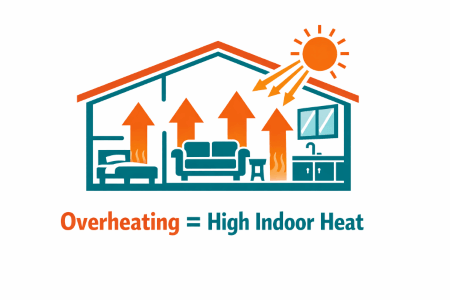
Overheating occurs when internal temperatures in a building rise to levels that are uncomfortable or harmful for occupants, particularly during warm weather and night-time periods.
In residential buildings, overheating is most commonly associated with:
- High levels of glazing
- Well-insulated and airtight envelopes
- Limited ventilation potential
- Dense urban locations
- Rising summer temperatures due to climate change
Unlike short-term temperature spikes, overheating is assessed based on frequency, duration, and timing of high temperatures — especially in bedrooms.
Why Overheating Matters
- Reduced sleep quality and wellbeing
- Increased health risks for vulnerable occupants
- Growing regulatory scrutiny
- Higher likelihood of post-occupancy complaints
Key insight: Overheating is now treated as a predictable design risk, not an operational anomaly.
2. The UK Regulatory Approach to Overheating
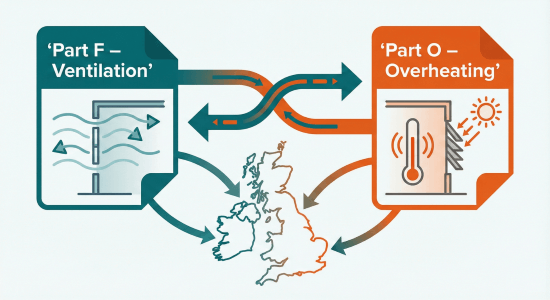
Overheating in new residential buildings is addressed through the Building Regulations, primarily Approved Document O (Overheating) and Approved Document F (Ventilation). These documents work alongside industry guidance such as CIBSE TM59.
Key Distinction: Understanding what each document covers is essential for compliance.
| Document | Primary Purpose |
|---|---|
| Part F | Indoor air quality & moisture control |
| Part O | Limiting high indoor temperatures |
| TM59 | Performance-based overheating assessment method |
They overlap physically (windows, vents, airflow) but answer different questions.
3. Approved Document F – Ventilation Explained
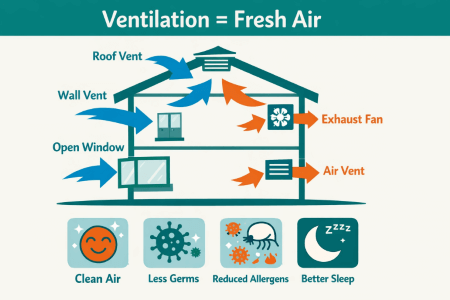
Approved Document F (2021) ensures that dwellings receive adequate ventilation to maintain good indoor air quality. It covers minimum ventilation rates, extract ventilation, and purge ventilation requirements.
What Part F Covers
- Supply of fresh air
- Removal of moisture and pollutants
- Minimum ventilation rates
- Background ventilators (trickle vents)
- Purge ventilation via openings
What Part F Does NOT Assess
- Solar gains
- Orientation
- Urban heat island effects
- Summer thermal comfort
Important: A dwelling can fully comply with Part F and still be at high risk of overheating.
Typical Part F Checks (Simplified)
- Extract ventilation provided to all wet rooms
- Minimum whole-dwelling ventilation rate achieved
- Purge ventilation provided in all habitable rooms
- Minimum opening or equivalent areas met
- Background ventilators sized and distributed correctly
Quick tip: Part F is a minimum ventilation standard, not a thermal comfort assessment.
4. Approved Document O – Controlling Overheating
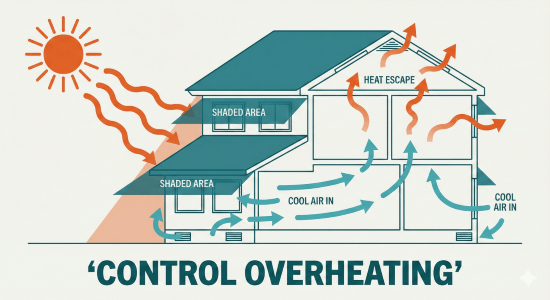
Approved Document O (2021) was introduced to specifically address the risk of overheating in new residential buildings. Its aim is to protect occupant health and welfare by limiting unwanted solar gains in summer.
The Aim of Part O
To protect occupant health and welfare by:
- Limiting unwanted solar gains in summer
- Providing an adequate means of removing excess heat
Part O applies to new residential buildings only and is assessed at Building Regulations stage.
The Two Part O Compliance Routes
Part O allows compliance to be demonstrated using one of two methods:
1. Simplified Method
A rule-based approach using fixed geometric criteria.
- Glazing area limits
- Opening area thresholds
- Based on orientation & location
2. Dynamic Thermal Modelling
A performance-based approach using CIBSE TM59, subject to constraints defined in Part O.
- Hour-by-hour simulation
- Weather data analysis
- Greater flexibility
How the routes relate: Both routes are permitted under Part O. You can choose either the simplified method or dynamic modelling upfront. However, if a design fails the simplified method (e.g., exceeds glazing limits or lacks sufficient opening area), dynamic thermal modelling using TM59 becomes the required route to demonstrate compliance. A scheme that fails simplified may still pass via TM59 modelling if the design performs adequately under simulation.
5. Part O Simplified Method – How It Works

The simplified method assesses overheating risk using set thresholds rather than modelling. It uses geometric rules based on glazing area, opening area, orientation, and location.
It checks two things only:
A. Limiting Solar Gains
By restricting:
- Total glazing area (% of dwelling floor area)
- Glazing area in the most glazed room
These limits vary based on:
- Orientation of the largest glazed façade
- High-risk or moderate-risk location
- Presence of cross-ventilation
B. Removing Excess Heat
By requiring minimum:
- Total opening free area (whole dwelling)
- Bedroom opening free area
Again dependent on:
- Location risk
- Cross-ventilation status
Key Inputs (Simplified Method)
- Floor areas
- Glazing areas
- Opening areas
- Orientation
- Location risk category
Cross-Ventilation – Strict Definition
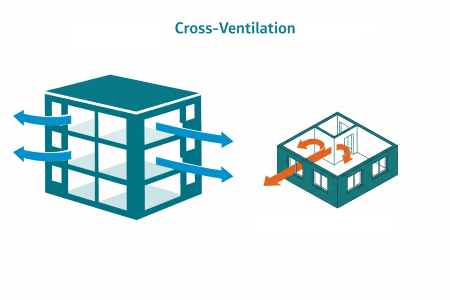
Under Part O, cross-ventilation exists only where openings are provided on opposing façades. This is a strict definition that directly impacts compliance requirements.
Important clarifications:
- Corner flats do not count as cross-ventilated
- Each dwelling or unit is assessed individually
- Cross-ventilation directly affects allowable glazing and opening thresholds
Common pitfall: Misclassification of cross-ventilation status is one of the most common causes of compliance failure.
Location Risk in Part O
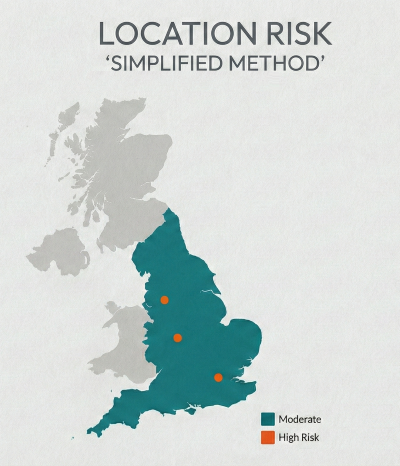
For the simplified method, sites are categorised as Moderate Risk (most of England) or High Risk (urban London and central Manchester areas). Location directly affects glazing limits.
For the simplified method, sites are categorised as:
| Risk Category | Areas Covered |
|---|---|
| Moderate Risk | Most of England |
| High Risk | Urban and some suburban parts of London (plus some central Manchester postcodes) |
High-risk locations:
- Allow less glazing
- Require larger opening areas
This is a binary classification, not a climate model.
Limitations of the Simplified Method
The Part O simplified method does not consider:
- Internal heat gains
- Occupancy patterns
- Shading from nearby buildings (beyond basic rules)
- Noise preventing window opening
- Security or fall-risk constraints
- Night-time usability of openings
Where these issues are significant, Part O explicitly allows the dynamic thermal modelling route to be used instead.
Quick tip: Passing the simplified method does not mean a dwelling will be comfortable — it means it meets a conservative regulatory threshold.
6. Dynamic Thermal Modelling & TM59
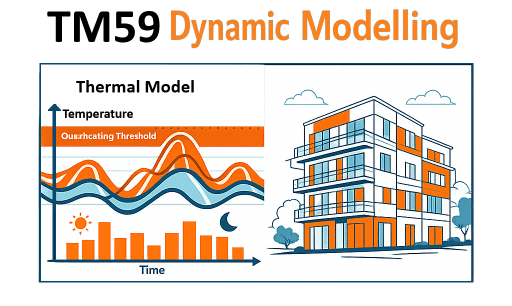
Where greater flexibility or realism is required, Part O allows compliance to be demonstrated using dynamic thermal modelling, following CIBSE TM59. This is the performance-based alternative to the simplified method.
What is TM59?
- A CIBSE methodology for assessing overheating risk in homes
- Referenced by Part O as the approved dynamic assessment route
- Uses hour-by-hour computer simulation across a full summer period
- Accounts for real-world factors the simplified method cannot capture
Why Choose Dynamic Modelling?
Dynamic modelling offers several advantages over the simplified method:
- Flexibility: Can demonstrate compliance even when glazing exceeds simplified method limits
- Realism: Accounts for thermal mass, shading, occupancy patterns, and actual weather data
- Design freedom: Allows innovative solutions that rule-based methods can't evaluate
- Required route: Becomes mandatory if the simplified method fails or cannot be applied
TM59 is not legislation, but it is the recognised method for dynamic assessment under Part O. If your design fails the simplified method, TM59 becomes your required compliance route.
How TM59 Works
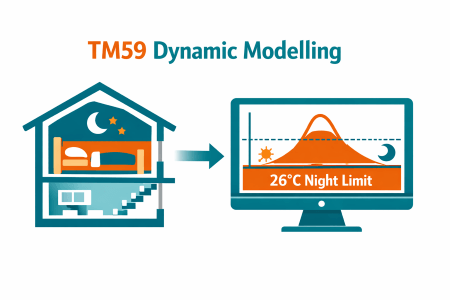
Understanding what goes into a TM59 assessment helps design teams make better decisions early, when changes are easiest. Bedrooms are assessed for night-time temperatures (10pm-7am) with a 26°C threshold.
The Simulation Process
TM59 uses dynamic simulation software (IES VE, TAS, DesignBuilder) to model:
- Hour-by-hour internal temperatures throughout the summer assessment period
- Solar gains through glazing based on orientation, area, and g-value
- Thermal mass of construction materials (how the building absorbs and releases heat)
- Ventilation heat loss from window opening and mechanical systems
- Internal gains from occupants, lighting, and equipment
Pass/Fail Criteria
Overheating is assessed against two key criteria:
- Criterion A: Hours above a threshold temperature (adaptive comfort in living areas)
- Criterion B: Bedroom night-time temperatures must not exceed 26°C for more than 1% of annual hours (32 hours)
Bedrooms are often the hardest to pass. Night-time cooling depends on windows being open, but security, noise, and safety constraints may prevent this in practice.
Understanding TM59 Results
A TM59 assessment provides detailed data on thermal performance. Understanding what the numbers mean helps design teams respond effectively.
The Two Key Criteria Explained
Criterion A: Hours of Exceedance
Applies to: All occupied rooms (living rooms, kitchens, bedrooms)
Threshold: Operative temperature should not exceed the adaptive comfort limit by more than 1K for more than 3% of occupied hours during May to September.
In practice: This typically allows around 40 to 50 hours of exceedance depending on occupancy assumptions.
Criterion B: Bedroom Night Temperature
Applies to: Bedrooms only (10pm to 7am)
Threshold: Operative temperature must not exceed 26 degrees C for more than 1% of annual hours.
In practice: This means no more than 32 hours above 26 degrees overnight. If a bedroom reaches 33+ hours, it fails.
Both criteria must be met. A bedroom that passes Criterion A but fails Criterion B still fails the overall assessment. Bedrooms are typically the hardest rooms to pass because night-time cooling depends heavily on window opening.
For Mechanically Ventilated Dwellings
Where dwellings have restricted window opening (e.g., sealed windows with MVHR only), a different fixed threshold applies:
- All occupied rooms should not exceed 26 degrees C for more than 3% of annual occupied hours
- This is a more stringent test than the adaptive criteria used for naturally ventilated homes
Common Failure Patterns and What They Indicate
High Criterion A failures across multiple rooms
- Likely cause: Excessive glazing, poor shading, inadequate ventilation openings
- Action: Review glazing ratios (especially south/west), add external shading, increase opening areas
Criterion B bedroom failures only
- Likely cause: Insufficient night-time cooling, often due to security or noise constraints limiting window opening
- Action: Consider alternative ventilation (secure night vents, high-level openings), reduce bedroom glazing, improve thermal mass
West-facing rooms consistently failing
- Likely cause: Low afternoon sun is hardest to shade; coincides with peak external temperatures
- Action: Prioritise west-facing windows for shading or g-value reduction; consider layout changes
Top-floor apartments performing worst
- Likely cause: Heat transmission through roof, less thermal mass, reduced ability to stack-ventilate
- Action: Enhanced roof insulation, increased ventilation provision, consider higher ceilings
Marginal failures (1 to 5 hours over threshold) can often be addressed with small design tweaks. Significant failures (20+ hours over) typically require more substantial changes to glazing, shading, or ventilation strategy.
7. Key Factors That Affect TM59 Results

These design decisions significantly impact TM59 outcomes—address them early in the design process for best results.
1. Glazing Specification
- Lower g-values reduce solar gains but also reduce daylight—balance is key
- West-facing glazing is highest risk (afternoon sun + peak temperatures)
- Large areas of unshaded south/west glazing rarely pass without mitigation
2. Construction & Thermal Mass
- Heavyweight construction (concrete, masonry) absorbs daytime heat and releases it slowly
- Lightweight construction (timber frame) responds quickly—can overheat faster but also cool faster at night
- Envelope details matter: Insulation values, construction layers, and airtightness all affect results
3. Ventilation Strategy
Ventilation system type significantly affects overheating risk:
- Natural ventilation: Relies on openable windows—most effective but subject to usability constraints
- System 3 (MEV): Continuous extract—provides background ventilation but limited cooling
- System 4 (MVHR): Heat recovery ventilation—efficient for heating season but can worsen overheating if not bypassed in summer. MVHR systems must have summer bypass functionality.
4. Part K2 Overlap – Window Safety Restrictions
Often overlooked: Part K2 (Protection from Falling) restricts how windows can open where the cill is less than 1100mm above floor level. This can prevent windows from being included in the overheating strategy. If windows can't open safely, they can't contribute to Part O compliance—this must be considered early in design.
5. Noise & Security Constraints
- If windows are unlikely to be opened at night (busy roads, ground floor security), Part O requires this to be accounted for
- This often means reduced opening areas in modelling or alternative ventilation strategies
Early design tip: The decisions that most affect TM59 results—glazing ratios, orientation, shading, and ventilation strategy—are typically fixed by RIBA Stage 3. Engage on overheating before designs are locked in.
8. Passive and Active Mitigation Strategies
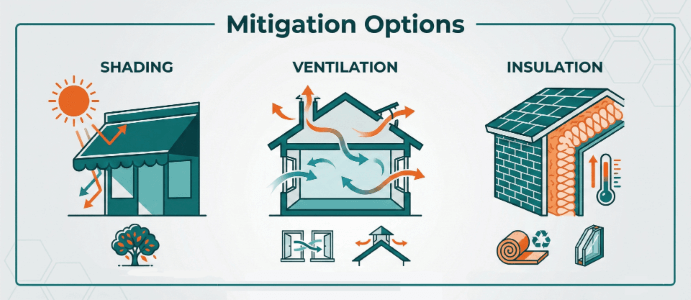
Overheating mitigation follows a clear hierarchy: prioritise passive measures (shading, ventilation) first, with mechanical cooling only as a last resort.
Passive Measures (First Priority)
- Glazing size and distribution
- Orientation and layout
- External shading
- Thermal mass
- Ventilation strategy
Active Measures (Last Resort)
Mechanical cooling may only be used where sufficient heat cannot reasonably be removed using passive means.
Important: This hierarchy is embedded directly within Part O.
9. Important Limits on TM59 (Part O Context)
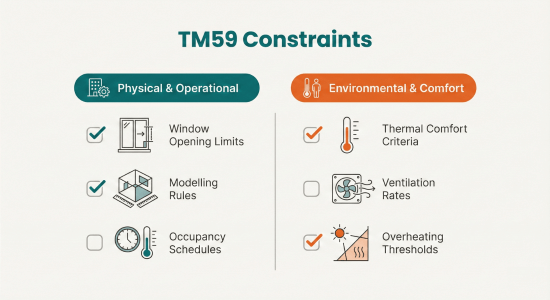
When TM59 is used to demonstrate Part O compliance, modelling assumptions are constrained to ensure consistency and prevent over-optimistic results.
Examples include:
- Defined window opening behaviour
- Restrictions on night-time opening for accessible rooms
- Requirement to prioritise passive measures
- Entrance doors modelled as closed
This ensures consistency and prevents over-optimistic assumptions.
10. TM52 vs TM59: When to Use Each
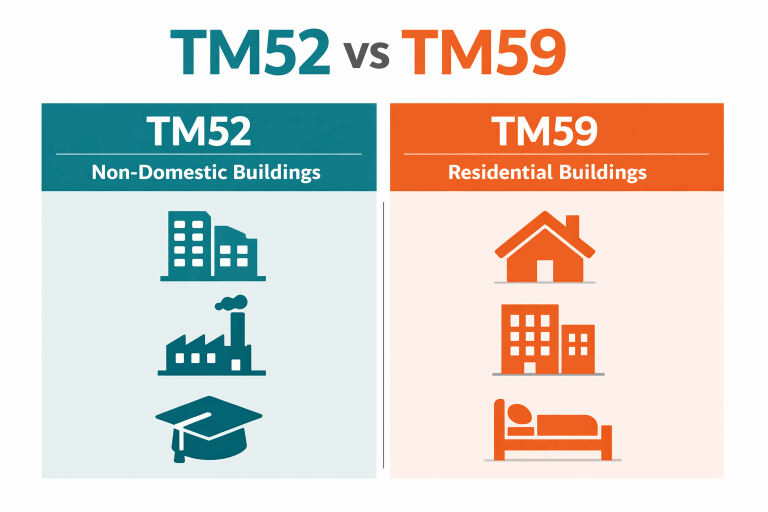
Both TM52 and TM59 are CIBSE methodologies for assessing overheating, but they apply to different building types and contexts. Understanding which applies to your project is essential.
CIBSE TM52
Focus: Non-domestic buildings (offices, schools, healthcare, etc.)
- Uses three adaptive thermal comfort criteria
- Based on operative temperature thresholds
- Designed for buildings with typical daytime occupancy
- Referenced in BREEAM assessments
CIBSE TM59
Focus: Residential buildings (houses, flats, care homes)
- Includes specific bedroom night-time criteria
- Accounts for sleeping hours (10pm-7am)
- Referenced by Part O for compliance
- Uses DSY weather files for future climate
Key Differences Explained
| Aspect | TM52 | TM59 |
|---|---|---|
| Building Type | Non-domestic | Residential |
| Occupancy Hours | Daytime (working hours) | 24-hour (including sleeping) |
| Bedroom Criteria | Not applicable | Specific night-time thresholds |
| Regulatory Link | BREEAM, some local policies | Part O (Building Regulations) |
| Weather Data | DSY files | DSY1, DSY2, DSY3 (varying severity) |
Quick rule: If the building contains bedrooms (residential, hotels, care homes), TM59 is typically required. For offices, schools, and other non-domestic buildings, TM52 applies.
Which Weather File Should Be Used?
TM59 uses Design Summer Year (DSY) weather files to simulate overheating risk:
- DSY1: Moderately warm summer — the standard assessment scenario
- DSY2: Intense short-term heatwave (typically 2-3 weeks)
- DSY3: Prolonged period of warm weather
Part O requirement: For Building Regulations compliance, assessments typically use DSY1. However, projects in high-risk areas or for vulnerable occupants may need additional testing with DSY2 or DSY3.
11. When is Overheating Assessed?
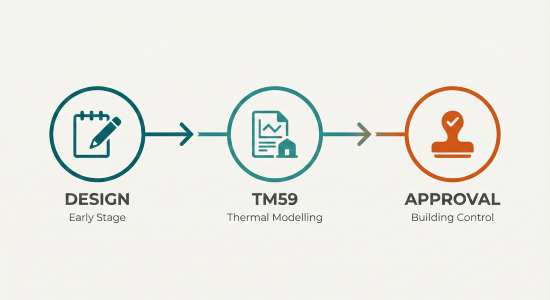
Although Part O and TM59 apply at Building Regulations stage, decisions made earlier often determine the outcome. Engaging at RIBA Stage 2-3 leads to best results.
Early consideration of overheating helps:
- Avoid late design changes
- Reduce reliance on mechanical cooling
- Improve coordination with daylight and massing decisions
What a TM59 / Part O Report Typically Includes
A clear overheating assessment report usually sets out:
- Description of the building and assumptions
- Chosen Part O compliance route
- Key inputs and constraints
- Results and interpretation
- Mitigation strategy and conclusions
Transparency and clarity are essential for Building Control review.
12. Future Regulations: What Is Coming Next
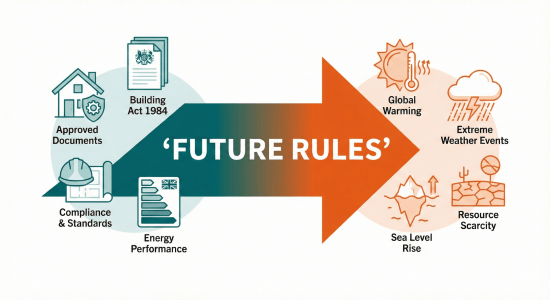
Overheating regulations are evolving. The Future Homes Standard (2025+) will require 75-80% carbon reduction with enhanced Part O principles for net-zero ready homes.
The Future Homes Standard (2025 onwards)
The Future Homes Standard represents the next major update to Building Regulations for residential buildings:
- Implementation: Expected from 2025, with full compliance required by 2027
- Carbon targets: 75 to 80% reduction in carbon emissions compared to current regulations
- Overheating integration: Part O principles will be embedded and potentially strengthened
- Passive design emphasis: Greater priority on fabric-first solutions and passive cooling
Material Change of Use Consultation
A 2024 consultation explored extending Part O requirements to buildings undergoing material change of use (e.g., office-to-residential conversions). This could significantly expand the scope of overheating assessments beyond new-build.
Climate Projections
Current assessments use 2020s climate data, but the Met Office projections (UKCP18) show:
- Summer temperatures increasing by 2 to 4 degrees C by mid-century
- More frequent and intense heatwaves
- Urban heat island effects intensifying in cities
Forward-thinking: Designs that pass Part O today should ideally have headroom to cope with future climate. Some clients request additional testing with 2050s weather files for longer-term resilience.
13. Overheating and Daylight – The Design Crossover
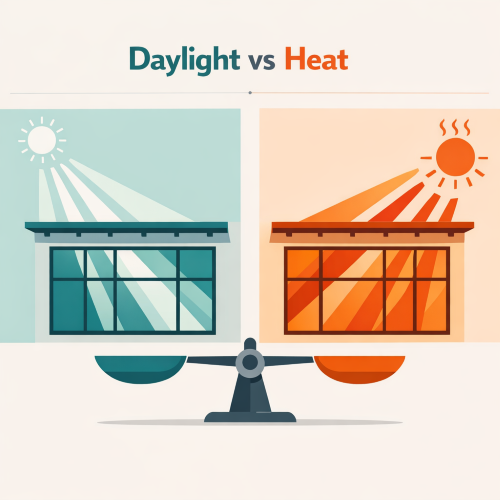
Overheating and daylight performance are closely linked: larger windows improve daylight but increase solar gains. Balancing these competing requirements is crucial.
- Larger windows improve daylight but increase solar gains
- Shading affects both daylight access and thermal comfort
- Urban form influences both ventilation and overshadowing
Addressing these factors together leads to more balanced and robust designs.
14. Ventilation, Usability & Part F Overlap
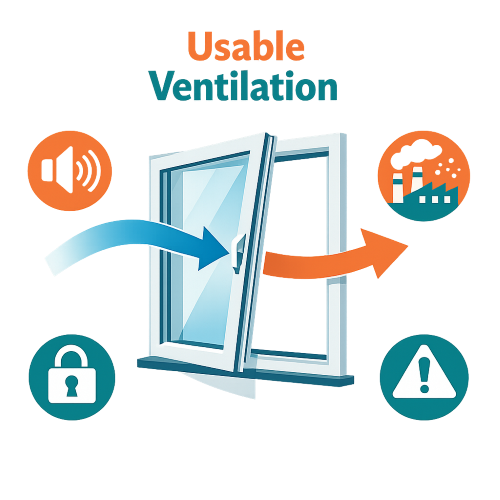
Part O requires overheating strategies to be usable in practice. External factors like noise, security, and pollution may prevent window opening and must be considered.
This means considering:
- Noise at night
- Air pollution
- Security risks
- Protection from falling
- Entrapment risks
Where windows are unlikely to be opened due to these factors, the simplified method may no longer be appropriate — and dynamic modelling is often required.
TM59 & Overheating Queries
Regulations & Compliance
Is a TM59 assessment a legal requirement?
TM59 itself is not legislation—it's a CIBSE methodology. However, Part O of the Building Regulations requires new residential buildings to address overheating risk, and TM59 is referenced as the accepted method for dynamic thermal modelling compliance. So while TM59 isn't mandatory, it's often the required route when the simplified method isn't suitable.
When does Part O apply to my project?
Part O applies to all new residential buildings in England from June 2022 onwards. This includes new-build houses, flats, conversions creating new dwellings, and extensions that create new habitable rooms. It does not apply to existing buildings unless you're creating new residential units.
Can I choose between the simplified method and dynamic modelling?
Yes, Part O allows compliance via either route. However, the simplified method has limitations and may not be appropriate where there are noise constraints, security concerns, or other factors affecting window usability. In such cases, dynamic thermal modelling (TM59) provides more flexibility and realistic assessment.
What happens if my development fails a TM59 assessment?
Failing isn't the end—it identifies areas needing improvement. Options include design modifications (reduced glazing, improved shading, better ventilation), exploring different unit layouts, or in some cases mechanical cooling. Early assessment helps avoid costly late-stage changes.
Does Part O apply in Scotland, Wales, or Northern Ireland?
Part O currently applies to England only. Scotland, Wales, and Northern Ireland have their own building regulations, though overheating is increasingly being considered. Projects in these regions may still need TM59 assessments for planning conditions or BREEAM requirements.
Assessments & Methodology
What is the difference between TM52 and TM59?
TM52 applies to non-domestic buildings (offices, schools) using daytime occupancy criteria. TM59 applies to residential buildings and includes specific night-time bedroom criteria. If your building has bedrooms, TM59 is typically required.
How long does a TM59 assessment take?
Timescales depend on project complexity. A typical single dwelling might take 1-2 weeks. Larger developments with multiple unit types may require 3-4 weeks. Early engagement allows for design iteration and reduces overall timeline.
What information do you need to start an assessment?
For a TM59 assessment, we typically need:
- Floor plans with room uses identified (living, bedroom, kitchen, etc.)
- Elevations showing glazing areas, positions, and window types
- Sections showing floor-to-ceiling heights
- Site location and building orientation
- Window and glazing specifications (frame type, opening mechanism, g-value if known)
- Envelope/construction details – all materials and their layers for walls, roof, floors, and glazing (U-values are helpful)
- Proposed ventilation strategy (natural, System 3, MVHR, etc.)
We build fresh 3D thermal models in specialist simulation software, so CAD exports aren't essential—but accurate drawings are.
What weather data is used in TM59 assessments?
TM59 uses Design Summer Year (DSY) weather files representing future climate scenarios. DSY1 is the standard assessment (moderately warm summer). DSY2 and DSY3 represent more extreme conditions and may be required for vulnerable occupant groups or high-risk locations.
Can a Part F ventilation assessment substitute for TM59?
No. Part F addresses air quality and moisture control, not thermal comfort. You can fully comply with Part F and still have significant overheating risk. Both assessments may be required, and they serve different purposes.
Design Teams & Architects
At what design stage should we commission a TM59 assessment?
Ideally at RIBA Stage 2-3 (concept/developed design) when massing, orientation, and unit layouts are being finalised but changes are still feasible. Commissioning too late (Stage 4+) can result in costly redesigns or reliance on mechanical cooling.
Can you work with our design team during the project?
Absolutely. We regularly collaborate with architects, M&E engineers, and planning consultants throughout the design process. This includes design workshops, iterative testing of options, and coordination with other environmental requirements like daylight assessments.
How does overheating assessment relate to daylight design?
The two are closely linked—larger windows improve daylight but increase solar gains and overheating risk. Shading solutions affect both. We recommend coordinating overheating and daylight assessments together to find balanced solutions that work for both requirements.
What design changes help pass a TM59 assessment?
Common effective strategies include:
- Redistributing glazing or reducing glazed area
- Adding external shading (brise soleil, overhangs)
- Ensuring openings on opposing facades for cross-ventilation
- Increasing ceiling heights for better thermal stratification
- Specifying solar control glazing (low g-value)
Process & Costs
How much does a TM59 assessment cost?
Costs vary by project scale and complexity. A typical assessment for a residential development might range from £800 for a single dwelling to several thousand pounds for larger schemes with multiple unit types. We provide fixed-fee quotes based on your specific requirements.
Do you offer preliminary screening before full assessment?
Yes. A quick screening review can identify high-risk areas before committing to full modelling. This helps prioritise design focus and can save time and cost by addressing issues early. We can look at floor plans and identify likely problem areas within a few days.
What does a TM59 report include?
A comprehensive TM59 report typically includes:
- Project description and methodology
- Modelling assumptions and inputs
- Results for each room type assessed
- Pass/fail summary against TM59 criteria
- Recommendations for mitigation if needed
- Supporting graphics and data tables
Can your assessment be used for Building Control sign-off?
Yes. Our TM59 assessments are prepared to meet Part O requirements and are suitable for Building Control submission. Reports clearly set out the compliance route, assumptions, and evidence required for sign-off.
Do you cover projects outside London?
Yes, we work on projects across England and can assess schemes in any location. While London has specific high-risk zones with stricter requirements, overheating risk exists nationwide and Part O applies to all new residential buildings in England.
Health & Wellbeing
What are the health risks of overheating in homes?
Prolonged exposure to high indoor temperatures can affect health in several ways:
- Sleep disruption: Bedroom temperatures above 24°C significantly impair sleep quality
- Heat stress: Can cause dehydration, heat exhaustion, and in severe cases heat stroke
- Vulnerable groups: Elderly, infants, and those with respiratory or cardiovascular conditions are at higher risk
- Productivity: Cognitive function and concentration decline in overheated environments
These concerns are why Part O was introduced—to address overheating as a health issue, not just comfort.
Are some occupants more vulnerable to overheating than others?
Yes. Vulnerable groups include:
- Elderly residents (reduced thermoregulation ability)
- Young children and infants (higher metabolic rate, less body awareness)
- People with chronic health conditions (cardiovascular, respiratory)
- Those on certain medications affecting temperature regulation
- Residents with limited mobility who cannot easily move or seek cooler areas
Care homes and sheltered housing projects often require more stringent overheating criteria or additional testing with extreme weather files (DSY2/DSY3).
How does climate change affect overheating risk?
Climate projections indicate UK summers will become hotter and more unpredictable. TM59 assessments use future climate scenarios (2020s, 2050s, 2080s weather files) to account for this. Buildings designed today need to remain comfortable for their 60+ year lifespan, which is why forward-looking weather data is used rather than just historical records.
Does overheating affect mental wellbeing?
Yes. Research links high indoor temperatures to:
- Increased stress and irritability
- Lower mood and reduced sense of wellbeing
- Sleep deprivation effects on mental health
- Reduced productivity and concentration in home workspaces
Good thermal comfort design supports both physical and mental health outcomes.
Mitigation Strategies
What is the most effective way to reduce overheating risk?
There's no single answer—the most effective strategy depends on the specific design. However, external shading (brise soleil, overhangs, shutters) is often the most impactful single intervention, as it stops solar heat before it enters the building. Other key strategies include reducing excessive glazing, ensuring cross-ventilation potential, and specifying solar control glass.
Can mechanical cooling (air conditioning) be used for Part O compliance?
Yes, but only as a last resort. Part O explicitly requires passive measures to be prioritised first. Mechanical cooling can only be proposed where it can be demonstrated that sufficient heat cannot reasonably be removed by passive means. If cooling is used, the system must be capable of maintaining bedroom temperatures below 26°C during sleeping hours.
What types of shading work best for overheating control?
External shading is significantly more effective than internal blinds:
- Fixed overhangs: Block high summer sun while allowing low winter sun—good for south-facing glazing
- Brise soleil: Horizontal or vertical louvres that filter light and heat
- External shutters: Highly effective, occupant-controlled
- Balconies: Can provide shading to units below if designed correctly
Internal blinds reduce glare but allow most solar heat to enter the room. Solar control glass (low g-value) is a middle ground solution.
Does glazing specification matter for overheating?
Absolutely. Key glazing properties include:
- g-value (solar factor): Lower values (0.3-0.4) reduce solar heat gain
- Light transmittance: Affects daylight levels—balance with g-value needed
- Glass type: Triple glazing retains more heat at night; consider ventilation strategy
Very low g-values can harm daylight performance, so specification requires careful balance.
How does ventilation strategy affect overheating?
Ventilation is crucial for removing accumulated heat. Key considerations:
- Cross-ventilation: Openings on opposing facades create airflow—much more effective than single-aspect
- Night-time purge: Cooling the building overnight when external temperatures drop
- Opening sizes: Part O specifies minimum free areas for heat removal
- Window type: Casement and tilt-turn openers typically provide larger free areas than sliding windows
Can building orientation help reduce overheating?
Yes, though it's often fixed by site constraints. In general:
- South-facing: High summer sun is easier to shade with overhangs
- West-facing: Receives low-angle afternoon sun (hardest to shade) and warmer air temperatures—highest risk orientation
- East-facing: Morning sun before peak temperatures—lower risk than west
- North-facing: Lowest solar gain—rarely problematic for overheating
Where west-facing glazing is unavoidable, reduced window sizes or enhanced shading is essential.
Technical Scenarios
Do single-aspect flats require TM59 assessment?
Usually yes. Single-aspect dwellings (windows on one facade only) have limited natural ventilation potential and are recognised as having considerable overheating risk. They typically cannot use the simplified method and require dynamic thermal modelling via TM59 to demonstrate Part O compliance.
Do corner flats count as cross-ventilated?
No. Part O explicitly defines cross-ventilation as having openings on opposite facades. Corner flats with windows on two adjoining walls (e.g., south and west) do not qualify as cross-ventilated. This is a common misunderstanding that can lead to compliance failures.
How are rooflights treated under Part O?
Rooflights present a challenge. Under the simplified method, rooflights and roof windows are not explicitly included in the standard calculations. For rooms primarily lit by rooflights, dynamic thermal modelling is often necessary. Rooflights can contribute significant solar gains and are typically harder to shade than vertical glazing.
What if noise levels prevent windows being opened?
Part O recognises this issue. If external noise levels exceed defined limits (typically 45dB LAeq for bedrooms at night), the assessment must assume windows cannot be relied upon for ventilation during those hours. This significantly affects compliance strategy and may require:
- Mechanical ventilation with summer bypass
- Acoustic ventilators that allow airflow with windows closed
- Stricter limits on glazing to reduce heat gains
Can internal blinds be counted in overheating calculations?
No. Internal blinds and curtains cannot be included as part of the overheating mitigation strategy for Part O compliance or in TM59 calculations. This is because they allow solar radiation to enter the building before providing any shading effect. Only external shading devices or solar control glazing can be credited.
Does Part O apply to buildings with communal heating?
The simplified method is not suitable for buildings with multiple residential units that use communal heating or hot water systems with significant horizontal pipework. These buildings typically require TM59 dynamic modelling because the heat gains from distribution pipework can significantly affect overheating risk.
Does Part O apply to extensions or conversions?
Currently no for most extensions and conservatories added to existing buildings. Part O applies to new residential buildings. However, conservatories on new-build properties must comply, and a 2024 consultation explored extending requirements to buildings undergoing material change of use (e.g., office-to-residential conversions). This may change in future.
How does Part O interact with other Building Regulations?
Part O compliance can affect and be affected by several other regulations:
- Part F (Ventilation): Window opening requirements for air quality overlap with overheating ventilation
- Part L (Energy): If mechanical cooling is used, it affects SAP calculations
- Part K (Falls): Restricts how windows with low cills can open, limiting their use for ventilation
- Part B (Fire): Escape window requirements may conflict with acoustic or security restrictions
- Part M (Access): Accessibility requirements for window controls
Early coordination between these requirements prevents conflicts at later stages.
What is the difference between high-risk and moderate-risk locations?
Part O categorises England into two risk zones:
- High-risk: Primarily urban and suburban London postcodes, plus some central Manchester areas. Stricter glazing limits and mandatory shading on certain orientations.
- Moderate-risk: The rest of England. More relaxed thresholds than high-risk areas.
The location classification affects both simplified method limits and the weather data used in TM59 modelling.
Can I use mechanical cooling to pass Part O?
Only as a last resort. Approved Document O explicitly states that mechanical cooling should only be considered where passive measures cannot reasonably remove sufficient heat. If cooling is used:
- The system must maintain bedroom temperatures below 26 degrees C at night
- SAP calculations must include the cooling energy use (affecting Part L compliance)
- You must demonstrate why passive measures were insufficient
What g-value should I specify for solar control glazing?
For overheating mitigation, glazing with g-value of 0.4 or below is typically considered solar control. However, lower g-values reduce daylight transmission:
- g-value 0.5-0.6: Standard double glazing
- g-value 0.3-0.4: Solar control glazing (good for south/west facades)
- g-value below 0.3: High-performance solar control (may impact daylight compliance)
For Part O simplified method, shading credits require glazing with maximum g-value of 0.4 and minimum light transmittance of 0.7.
How does thermal mass affect TM59 results?
Thermal mass (heavyweight construction materials like concrete, masonry) affects overheating in complex ways:
- Benefit: Absorbs heat during the day, reducing peak temperatures
- Challenge: Releases stored heat slowly, which can be problematic if night-time ventilation is limited
Heavyweight construction generally performs better where good night-time ventilation is available. Lightweight construction (timber frame) may be more suitable where night ventilation is restricted, as it cools faster once heat input stops.
What happens if only some units in a development fail?
Common scenario. Often it is the worst-case units that fail—typically top-floor, west-facing apartments with high glazing ratios. Options include:
- Targeted design changes to failing unit types only
- Different glazing specifications by orientation
- Additional shading to specific facades
- Layout modifications to move bedrooms away from critical orientations
Building Control requires all units to demonstrate compliance.
Resources
Free Downloads
Download our practical guides and checklists for TM59 overheating assessments and Part O compliance.
Whether you're an architect, developer, or building control officer, these resources help you navigate overheating requirements with confidence.
Assessment Route Checklist
Does your project need the Simplified Method or full TM59 Dynamic Modelling? Use this decision flowchart to find out.
- Cross-ventilation classification
- High-risk location trigger (London)
- Noise constraints & window restrictions
- When dynamic modelling is mandatory
Part O Report Requirements
Complete checklist of what Building Control expects in your Part O submission or TM59 report.
- Glazing schedule & g-values
- Window opening specifications
- Ventilation strategy documentation
- Shading & mitigation evidence
Part O Design Guide
Practical tips for optimising your design to pass Part O while balancing daylight, energy, and other Building Regs.
- Part K, Part Q & Part O trade-offs
- Glazing vs daylight optimisation
- Ventilation & acoustic conflicts
- Early-stage design strategies
Need a TM59 Overheating Assessment?
Get expert guidance on Part O compliance from our certified assessors.
Get a Quote Today📚 Key Terms & Definitions
- Part O (Approved Document O)
- 2021 Building Regulation addressing overheating risk in new residential buildings.
- Part F (Approved Document F)
- Building Regulation covering ventilation requirements for indoor air quality.
- TM59
- CIBSE Technical Memorandum 59 – Design methodology for assessment of overheating risk in homes.
- TM52
- CIBSE Technical Memorandum 52 – The limits of thermal comfort: avoiding overheating in European buildings.
- Simplified Method
- Rule-based Part O compliance route using fixed glazing and opening thresholds.
- Dynamic Thermal Modelling
- Performance-based assessment using hour-by-hour simulation software.
- Cross-Ventilation
- Ventilation achieved through openings on opposing façades of a dwelling.
- DSY (Design Summer Year)
- Weather data files used for overheating analysis, representing typical and extreme summer conditions.
- Operative Temperature
- A measure combining air temperature and radiant temperature, representing perceived thermal comfort.
- Purge Ventilation
- Rapid ventilation to remove pollutants or excess heat, typically via openable windows.
- High-Risk Location
- Under Part O, urban areas (mainly London) with stricter glazing and opening requirements.
- SAP Appendix P
- Simplified overheating check within the Standard Assessment Procedure for energy rating.